 Skip to content

No products added!

How well do you rate food safety in your business? Whether you manage a restaurant, a central kitchen, a catering business or a small food outlet, food safety depends on the everyday actions of your food handlers. In fact, even simple daily tasks can have a major impact on food safety if staff don’t carry them out correctly.
That’s why food safety practices shouldn’t just exist on paper. Instead, every team member needs to understand and apply them, on every shift.
Alt text: Food safety practices in Riyadh – cooking food to a safe core temperature of 75°C | File: food-safety-practices-cooking-temperature.jpg
Why Everyday Food Safety Practices Matter
Most foodborne illness outbreaks don’t come from rare or unusual events. Rather, they come from simple failures, such as undercooked food, a dirty chopping board or a fridge running too warm. According to the World Health Organization’s Five Keys to Safer Food, a handful of basic practices prevents most of these problems.
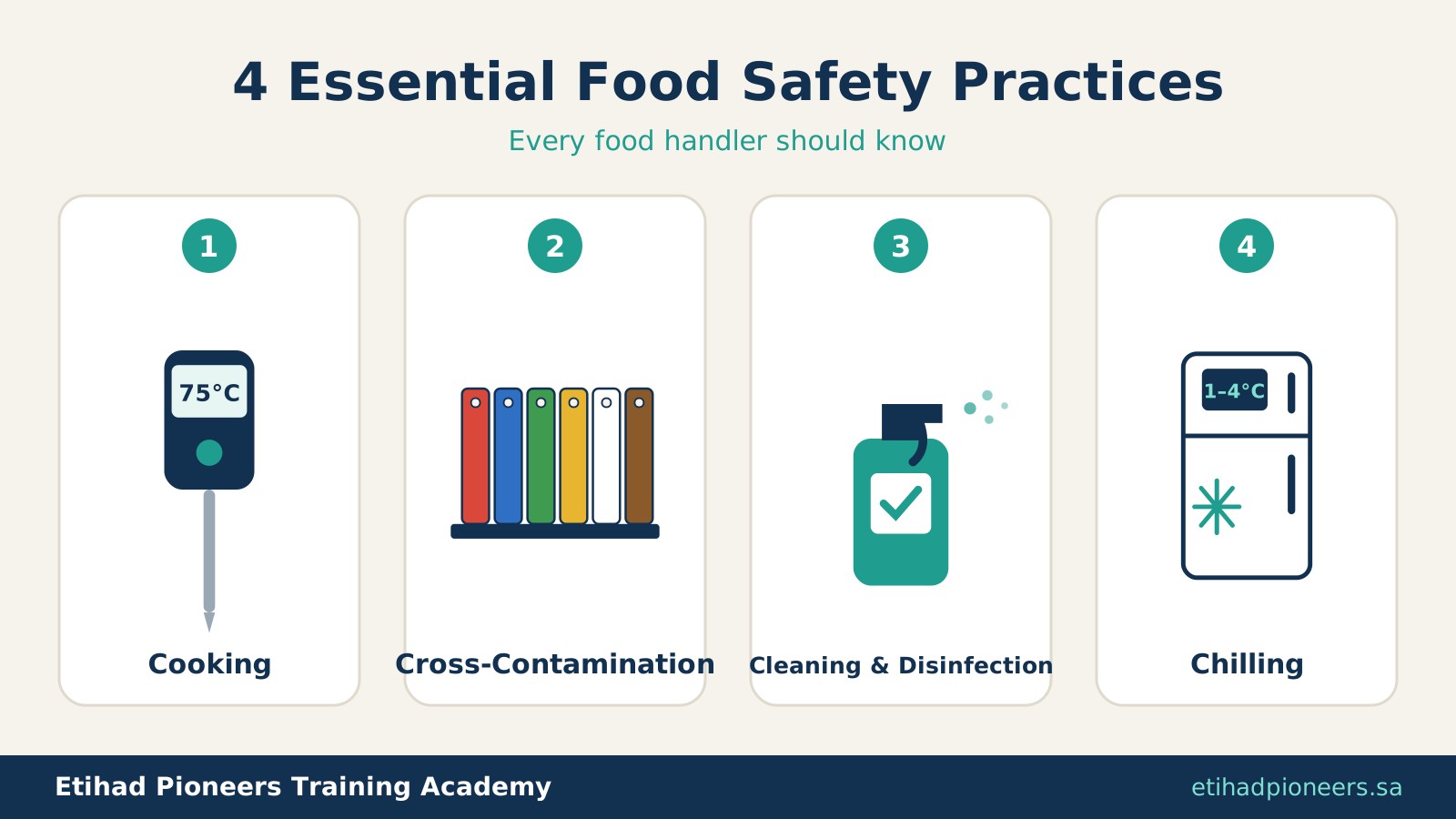
Here are four essential food safety practices that every food handler should understand.
1. Cooking
Cooking food thoroughly is one of the most effective ways to destroy harmful bacteria. For this reason, always cook food to a minimum core temperature of 75°C.
Good practice for food handlers:
- Use a clean, calibrated probe thermometer to check core temperatures
- Then insert the probe into the thickest part of the food
- Clean and disinfect the probe after every use, so it doesn’t spread bacteria
- Finally, record temperatures where your food safety system requires it
2. Preventing Cross-Contamination
Cross-contamination happens when harmful bacteria spread from raw food to ready-to-eat food. As a result, food that nobody will cook again can become unsafe.
Good practice for food handlers:
- Keep raw and ready-to-eat foods separate during storage, preparation and service
- In addition, use separate, colour-coded chopping boards, knives and equipment where necessary
- Also store raw meat and fish below ready-to-eat food in the fridge
- Similarly, clean and disinfect food-contact surfaces between tasks
- Finally, wash hands thoroughly after handling raw food
Alt text: Food safety training in Saudi Arabia – colour-coded chopping boards to prevent cross-contamination | File: food-safety-colour-coded-chopping-boards.jpg
3. Cleaning and Disinfection
Cleaning and disinfection are two different steps. Cleaning removes food residue and dirt, while disinfection reduces microorganisms to safe levels. Consequently, food handlers must carry out both steps correctly.
Good practice for food handlers:
- Clean first, then disinfect, since disinfectants work poorly on dirty surfaces
- Use suitable, food-grade cleaning and disinfection products
- Follow the manufacturer’s instructions for dilution and contact time
- Finally, follow a cleaning schedule, so your team doesn’t miss anything
4. Chilling
Proper refrigeration slows the growth of bacteria. Therefore, keep chilled food at the correct temperature at all times.
Good practice for food handlers:
- Keep chilled foods between 1°C and 4°C
- Also check and record refrigerator temperatures regularly
- Never leave perishable food at room temperature longer than necessary
- Avoid overloading fridges, because it stops cold air circulating
Training Turns Procedures into Daily Habits
Food safety isn’t just about having procedures in place. More importantly, it’s about making sure your team understands them and applies them every day.
At Etihad Pioneers Training Academy, we provide food safety training tailored to the knowledge, responsibilities and competency levels of your food handlers. Our courses include:
- Level 1 Food Hygiene, for new and entry-level staff
- Food Safety Level 2, for chefs, cooks and anyone handling open food
- HACCP Level 3, for supervisors and managers
We deliver training at our Riyadh facility or, alternatively, on-site in your kitchen anywhere in Saudi Arabia. After all, better-trained teams mean safer food, stronger practices and greater confidence in your establishment.
Book Food Safety Training for Your Team
Contact Etihad Pioneers to schedule food safety training for your food handlers in Riyadh or anywhere in Saudi Arabia.
Related courses: Hospitality Training | First Aid Training | Fire Safety Training
Call: +966 11 276 1171 | Email: info@etihadpioneers.sa | Visit: Etihad Pioneers Food Safety Training in Saudi Arabia


